Wednesday, May 14, 2014

Sure, your T&E costs aren’t the Wolf of Wall Street’s but are you managing the threats to this 2nd largest controllable cost?


In the movie The Wolf of Wall Street, Leonardo DiCaprio and Jonah Hill throw hundred-dollar bills in the trash, charter planes, stay in luxury penthouses, and toss cash off a balcony. The movie follows the trajectory of DiCaprio's character, Jordan Belfort, a party-minded stockbroker who spent 22 months in prison for market manipulation and running a penny stock boiler room in the '90s. When I saw the movie I also thought of his gross miss management of his firm's Travel and Expense (T&E) budget. One scene shows Rob Reiner – who plays Belfort's father and the firm CFO– freaking out over the fact that his son spent $26,000 on one dinner. Belfort then asks his business partner Azoff to tell his dad about "the sides." "What, they cure cancer?" asks Reiner's character. So while your T&E might not be that out of control and the abuses may or may not be illegal, can you access data that will assess your T&E spending so that you can identify dangers, opportunities, and strengths in this very significant line item? The data is available from your TMC, credit card company, and/or expense tools. It is easily available today if you have the right partners and the right direction from those partners. After all, simply telling your team to book where they want and make good decisions may have been the travel policy of Belfort's firm Stratton Oakmont!

To avoid these pitfalls and determine where you can determine the health of your travel program reach out to your TMC or join us on our webinar on May 29 at noon. For details on the webinar check here  14 Indicators of T & E Health for 2014 or contact Jess Cardenas at jcardenas@macnairtravel.com.

Thursday, May 1, 2014

My iPhone was and will be even more my secret weapon on the road. How do you address communications and smartphone tools in your travel policy?

While on my trek to Everest base camp in Nepal my phone was my secret weapon. It was the single most important device that I had with me and I used it often. In thinking about this critical business travel tool, I wondered how companies should direct and advise their road warriors on the use of such a tool, what should be required as policy, what is recommended as important uses of such a tool,  and what is an approved expense. I would love to hear your comments, I’d love to see what is written in your company policy, and I’d like to inspire a useful discussion for those of you who would like to enhance how you address communications while on travel.
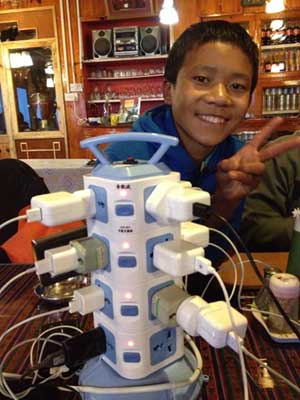

Power. A critical commodity. Charging my phone on the way to Base Camp.

Here are some of the ways I used my device and some observations:

Communication. I used my iPhone to communicate and had many options to enhance how this tool would operate. I checked with Verizon before I departed and understood the local charges. They were quite high. Many on the trip visited a local communications shop and purchased either a local Nepalese phone or a Nepalese SIM card. The other option is to communicate when Wi-Fi was accessible. I used FaceTime a few times, emailed the office and friends and family often from the phone, posted pictures and distributed updates on Facebook via the phone. To take it a step further, climbers at base camp had purchased a sleeve that turns the iPhone into a satellite phone. So from a communication standpoint, the options were endless. What do you direct employees to do and what constitutes approval for some upgraded communication tools when traveling to developing companies like Nepal?

Camera. My camera on my phone was the only camera I had. With a swipe of my thumb my camera was ready to take the amazing shots that I took. Panoramas, videos, selfies and more were easy to take, of high quality, and ready to post. I have had cameras before and others lugged around big cameras but I was amazed and satisfied with what I secured from this amazing device. While on work related projects do you limit what people are able to post or do you require or encourage them to take and post pictures so that the company is more engaged with the work related projects and activities that are going on? 


Me at Everest Base Camp. Photo taken with my iPhone.

Travel tools. I used it for my itinerary, boarding pass, confirmations, and more. These are all best practices for the most part. You could take it further in some parts of the world to secure an uber car, etc. (surely not in Nepal). Sharing best practices like this is also an important part of a great travel policy. Not all travelers are experienced in all types of travel (like travel to third world countries). They may assume they can do some things that wont work and may need to be directed to some other options. What do you do to train or brief travelers on before they travel for company business?

Maps/GPS. It was amazing to use this tool to map where we were on the trek. Many companies have tools to allow the phone to track where their employee is in case of emergencies. Safety and awareness are surely items to address.

 Medical. I am in my fifties with some failing body parts including my eyes. I used the phone for magnification and light when necessary. I wondered what other medical tools and best practices could be incorporated into the phone. Where should a traveler house and hold their medical details, lists of medications, right hospital to see in case of emergency, insurance data, evacuation data, etc.?

 Translation. I could get some Nepalese words and translation help from my translation app. I thought that some direction on how to secure some language knowledge before travel would be helpful and respectful.

Currency Conversation and Math. Determining the right currency conversion and the math that went along with it was extremely useful. Again with currency, there are many ways to secure foreign currency. What is your best practice and is it shared in your travel policy? 

Answers. Google anything when connected and you have your answer. That said, modern travelers want to know where to eat, what to see, what is dangerous, who to connect with, etc. There are many sources for this data. What is the best practice at your firm that sends your people to the right places while keeping them safe? 

Clock and Alarm. Knowing the local time and the time at home and elsewhere was helpful. 

Payment. Even some suppliers used their phone to allow me to pay for items by credit card that I would have needed cash for before. What is safe, what approved? 

I had the phone at arms length away in the side pocket of my hiking pants at all times and it was a revelation to see how useful this tool was and will be-even for this old man. I now know I could have used it more, been better prepared with it, and have some specific recommendations for our travelers. What are your best practices and how easily are they found?

On a sie note, one day in Kathmandu there was a street festival and while this impoverished country has significant hurdles to overcome, it's youth were doing what youth do worldwide. They were texting one another, taking selfies, and sharing pictures of the fun they were having. The world is coming together with tools like this and there are pros and cons to this. While seeing a Sherpa talk on the phone while hiking in the kumbu is a change from the past, the benefits and conveniences of these devices are powerful.

Thursday, April 24, 2014

A Travel Management Company and Travel Agency are NOT the same thing. Clarifying can help your T&E procurement system


At times the challenge with introducing a new travel procurement program is that your staff can think that you have just hired a travel agency to help them with travel. First of all, many don’t think they need help booking their trip. Secondly, they have no idea what a Travel Management Company does versus a travel agency.

So let’s start with not needing help making their travel arrangements. Quality TMCs have both online and call in systems to make easy and complex reservations however the traveler sees fit 24/7 in a managed environment. They also have teams to construct complex muti-leg international itineraries or even change/support reservations when schedules change or weather disrupts the industry. So at one point every traveler is going to need some help to get out of a jam and/or save time. When we say a managed environment we mean that the resulting reservation will make the traveler and the company who is purchasing the trip as happy as possible based on some defined policies, procedures and systemic expectations.
When you Google Corporate Travel Management (CMT) you come up with the following Wikipedia definition: CTM is the function of managing a company’s strategic approach to travel (travel policy), the negotiations with all vendors, day-today operation of the corporate travel program, traveler safety & security, credit-card management and T&E data management. CTM should not be confused with the work of a traditional Travel Agency. While agencies provide the day-to-day travel services to corporate clients, they are the implementing arm of what the corporation has negotiated and put forth in policy.*
In other words, CTM decides on the class of service that employees are allowed to fly, negotiates corporate fares/rates with airlines and hotels as well as sets forth the use of the corporate credit card. The agency on the other hand makes the actual reservation within the parameters given by the corporation and develops, supports, and or enforces the desires of both the company and its travelers. For most companies “travel & expenses” (T&E) costs represent the second highest controllable annual expense, exceeded only by salary & benefits, and is commonly higher than IT and/or real estate costs. T&E costs are not only limited to travel (airline, rail, hotel, car rental, ferry/boat, etc.) but include all costs incurred during travel such as staff & client meals, taxi fares, gratuities, client gifts, supplies (office supplies and/or services), etc. Furthermore, this area often includes meeting management, traveler safety & security as well as credit card and overall travel data management. The management of these costs are usually handled by the Corporate Travel Manager, a function that can be part of the Finance, HR, Procurement or Administrative Services Department. As this function touches on all of these areas in some form and represents such a major corporate expense, it stands to reason that this function should have equal ranking within a corporation as any other major division and not be seen as a sub-set of existing departments
So if you fully leverage these travel management opportunities, communicate what you will be having your TMC do from a B2B standpoint, clarify the difference between the B2B relationship you have established versus a retail travel agency relationship, track the results, and share progress and expectations with you team,  you can expect more compliance with the big picture value you should expect.

Tuesday, April 15, 2014

Travel Management Companies are Not Dead, In Fact They're Thriving


In a recent article by by Marilee Crocker titled Govt. Looks to Travel Agents for Lessons in Resilience , Marilee points out that the government has taken notice of the fact that in the travel agency industry, pointing out, “At the U.S. Bureau of Labor Statistics, economists who study productivity noted a significant and steady increase in the productivity of the travel agency industry—including both traditional and large travel sellers.”

Outsiders share with me all the time that they thought that travel agencies have gone away. I always have to explain how a Travel Agency (personal travel) is different from a Travel Management Company (business travel) and that the industry has been broken into niche markets. I also have to remind them that Online Travel Companies are travel agencies too and even have some humans behind them who consider themselves to be travel agents. We know from our experience that the increased use of technology has allowed us to grow as a company with less travel agents as a percentage of our larger size (35% of all of our reservation come to us through online tools we build, customize and support for our corporate customers) and with our travel agents who have kept pace with the productivity requirements of the business model by leveraging an amazing range of tools allowing them to do more in less time more effectively.

The article goes on to state that only the best can survive and have survived and they are investigating that mojo. I am glad we have it. I don’t see us going away any time soon (as a matter of fact this year is already on pace to be our biggest growth year ever), and these changes have made us a company that can embrace change. The rumors of our demise have been greatly exaggerated!
 

Wednesday, April 9, 2014

What is the Real Problem Regarding Rogue Behavior?


In a recent PhoCusWright survey it stated that 55% of travel is not being managed by a TMC (Travel Management Company). My experience in the marketplace has been that the real reason behind this high percentage is that no one is out there touting the benefits of a managed travel system for the company and the travelers. Travelers are focused on making their trips and the company should be focused on managing travel - the line item.

Who teaches mid sized companies the key tenants of a well managed travel procurement system – what I like to call the travel management ecosystem? Well, we do but not many more. The way to get business travelers to use a travel procurement system is to make the systems better and the benefits clear. The systems are getting better and with bigger data it's pretty darn great. Let's get our industry to teach travel procurement to the anarchists who manage every other possible expense except this one. Let's then help these believers address maverick spend in a meaningful way versus a way that seems to enable maverick behavior. Sales force and Google manage travel democratically yet uniquely. 


Thursday, April 3, 2014

First Class Service to Third World Charm


As many of you know, I left on March 30 for Kathmandu to take the trek up to Mt. Everest Base Camp with my longtime friend and customer John Carney. Flying well makes a big difference. I left the US yesterday on a business class ticket with Etihad Airways and was very well taken care of. Business class included amazing lay flat sleeping, allowing full and complete sleep on the first fourteen hours of the flight,  a large screen monitor chocked with movies and programs, an amazing international crew, service, and food - and that was in business class. First class had even larger more comfortable quarters and supposedly a private chef.
 
I had a four hour layover in Abu Dhabi. The airline arranged for a meet and greet at the gate. This caring and smiling representative escorted me and my new friends Audrey and Jeff to the first class lounge where we showered, had a spa treatment, and a nice personally prepared sit down meal. They are both heading to Everest as well (climbers and trekkers are beginning to find each other). Audrey is a trekker on my trip. Jeff is a climber who attempted to summit Everest with my friend John Carney and is back for his second attempt. It's great to be in this community, and the players can be identified from afar.  The lounge looked, smelled and acted like a Four Seasons. Travel at this level and these experiences are what makes me love what we do.  


The Etihad Representative escorted us to the next flight. Watching the Arab cultures walk through the airport and the Vegas like world outside in Abu Dhabi was fascinating. The Flight to Kathmandu was less than four hours. Another meet and greet had me an my new buddies get off the plane first and into a private van to baggage claim where my bags where pre pulled. Visa and passport control was clunky, but having gone through it first made it easy.
 
Upon entertaining Nepal, a real world experience began to change from a first class one to a third world country experience. You could tell the air was thick with pollution and the chaos of taxi drivers and private pickup vehicles with tons of signs and hordes of people yelling out their company or offer. I saw the Alpine Ascents (the company who is leading the expedition up Mt. Everest) sign and followed the crew to their van. We waited for one more traveler to arrive - Erin Carney, John's niece and my hiking buddy. She welcome the friendly face and off we left in the van through the chaotic streets highlighted by dimly lit shops to the Yak and Yeti hotel.
 
 
The hotel is a blend of what seems to be ancient Nepalese extravagance and sixties or seventies modern. A clean and calm retreat from the streets of Kathmandu. Our guides checked us in, we dropped our gear, and headed down for an Everest beer (yeah that's the name of the local beer) and some conversation. John and Nick (Johns college roommate and my soon to be trek mate) found us and the day ended with friends, travel tails, and grand expectations. After a great night sleep I write you today from a sunny lounge and bad cup of coffee. A great start to what is sure to be an amazing journey.

Friday, March 7, 2014

25 Transformations in 25 Years: The Many Benefits of the Cloud Help Transform Our Offering

In April 2007, we experienced a catastrophic service interruption. A main fiber trunk in our telco provider’s network was severed during some road construction and it brought down all our phone and Internet capabilities. Since 99% of our customers reach us via an e-mail or a call, we were down hard. Although we had a few consultants who were telecommuting and did not have service interruption at their homes, our servers and data bases located at HQ, were inaccessible. This happened mid-week and the service and financial impacts were considerable.

Later that year we made the decision to explore the “thin client” option. We’d already converted to a Voice over IP (VOIP) telephone system, so jumping onto the web all the way was the next logic step. The major hurdles were finding a cloud service provider that could host and interface with all the travel-industry specific systems and services. Unlike most companies that were fully in the cloud at that time, we were not using email as a “communication” tool, it provided over half of our revenue stream. We went for it and have never looked back.

The benefits go far beyond the technology. We are now able to recruit nationally, because anywhere Internet access exists, our team can plug in and be fully functional as if they were sitting in our offices. We realized this allowed us to seek out the best of the best and it doesn’t limit us to the DC Metro labor pool and it does not require us to relocate people. We now have employees in 12 states.

Furthermore, we have employees who are spouses of military members. New assignments meant relocating and losing that employee – not anymore. We have one consultant who has moved three times in the last seven year. She unplugs on Friday, plugs in on Monday and her clients don’t even know she’s moved! It has even allowed some of our employees to move to more reasonably priced areas of the country (versus the Washington DC area) and improve their lifestyles without ever losing their job, momentum, or client relationships.

We were able to close one of our offices, giving employees the option to work virtually all or part of the week. The savings in rent, transportation, utilities, etc. amounts to over $100,000 per year. Not to mention reducing our carbon footprint by keeping our employees off the roads and reducing our power consumption.

Our clients benefit from our distributed staff. No loss of power or phone/Internet service interruption due to weather or other causes render us unavailable. A good example of this is the “PAX” storm that hit the Washington DC area recently. There was massive snowfall where our Headquarters based employees live, but because of the cloud capabilities there were no major service interruptions even though a lot of businesses in the area were shut does and in some cases roads were not drivable due to weather. Our cloud capabilities allowed our local staff to plug in from home and work through the storm and, most importantly, assist the travelers in the area whose flights were delayed or cancelled. For our remote employees, it was business as usual.

Our cloud service provider, Cetrom, not only has independent redundant power at our local Network Operations Center (NOC) in Sterling, VA, that NOC is backed up by another in Denver, Co. If our customers and clients can’t reach us because both NOCs are down and all our employees are off-line, the country has much bigger problems than changing a traveler’s flight.

Late in 2013, we went the final yard and converted web-based version of our key operational platforms, most notably, Sabre, our GDS. This means nothing our employees need to fully support our clients and our company requirements is housed on a local computer. Any computer, connected from anywhere, is sufficient to deliver service excellence.

We have changed some operational functions to circumvent the fact that we don’t all work in the same building. Call in and fly in meetings, Skype, and two actual staff conferences per year have been included into our operational rhythm to build communication, teamwork, and training.